

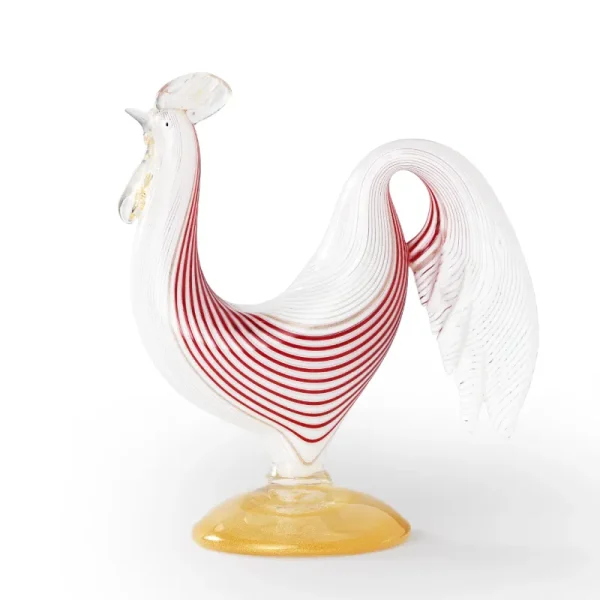
Rooster- shaped sculpture Galletto Galletto
Dino Martens (1894 – 1970)
Vetreria Artistica Rag. Aureliano Toso, 1954
It measures :
9.25 inches in height x 8.18 in x 4.4 in (23.5 cm x 20.8 cm x 11.4 cm) Peso: g 1.169
It weighs :
2.57 lb (1.169 g)
State of conservation:
intact
The small glass sculpture depicts a cockerel standing on a hemispherical base, with the crest open and turned back and the beak adorned with wattles. The object is made with a particular reed-blowing technique with “filigrana semplice” using “lattimo”, red and gold glass, and has details in achromatic paste and gold leaf. It was produced at the Vetreria Aureliano Toso from 1954 according to a design by Dino Martens.
In the factory archives the production of small roosters is documented starting from 1954: model no. 6095 by Martens (Cristina Beltrami, Giordana Naccari (a cura di), L’arca di vetro, La collezione di animali di Pierre Rosenberg, Milano, 2021, p. 153, n. [240]) is named in the archive: “filigrana semplice – Rooster on base” (M. Heiremans, Vetreria Aureliano Toso, Murano 1938-1968, Berlino, 2016, p. 330, model n. 6096, list 1954). In 1956 the glass factory began to produce other versions of roosters.
A precise comparison with this model comes from a similar sculpture exhibited in a recent exhibition, with an evocative title L’Arca di vetro. La collezione di animali di Pierre Rosenberg. This exhibition traced the history of twentieth century Murano glass, reinterpreted through a vast assortment and original creations of animal shapes. In this review, a Galletto similar to ours, but made with the reed-blowing technique with “filigrana semplice” using “lattimo” and black glass, is associated with the production of 1954 (Cristina Beltrami, Giordana Naccari (a cura di), L’arca di vetro, La collezione di animali di Pierre Rosenberg, Milano, 2021, p. 160, n. 240).
The history of Murano glass is varied and complex. Since the 1920s, the Murano tradition has evolved from the production of everyday objects to decorative ones: some glassmakers try their hand at creating human figures, sculptures, and zoomorphic elements in miniature.
The technique is refined and leads the artisans to devise new methods that allow the creation of both blown and massive figures.
A tradition of “Bagatelle” is known as early as the 16th century and throughout the 17th century and some objects come down to us from the wunderkammer as examples “alla maniera di Venezia (in the Venetian style)”. Some rare examples are preserved in museums. Among these, the plastic decorations of the chandeliers and other molded lanterns stand out.
However, only in the twentieth century did a real turning point in technique and design come about: a production that recently found its enhancement with the rediscovery of the sculptural works produced by the main historic Murano glassworks, from Ercole Barovier to Martinuzzi and Zecchin, as well as Flavio Poli and Dino Martens, in a succession of increasingly complex creations.
Between 1930 and 1960 the production of “bestiary” glass evolved and moved from the simpler forms of the Thirties to more complex works in terms of morphology and technique. All this is evident in the Forties with Barovier, and in the Fifties with Bianconi, who, along with Dino Martens, carried out research into designs using “filigrana” and polychromy, without neglecting the research into opacity by Archimede Seguso. The glass animal thus becomes and remains an obligatory passage in Murano artistic production, a work of experimentation and formal research, inspired both by reality and the inventiveness of its creation.
The work of Dino Martens (1894 – 1970) fits into this context, considered by many to be an artist with a gift for glass work. After the early postwar period, he trained at the Accademia di belle arti di Venezia and initially dedicated himself to painting. After his initial experiences with glass with SALIR and with Salviati & C., he arrived in 1939 at the manufacture of the ragionier Aureliano Toso. It was here that he would become artistic director until 1963, experimenting with the material to create completely new color and formal effects.
Bibliography:
- Cristina Beltrami, Giordana Naccari (a cura di), L’arca di vetro, La collezione di animali di Pierre Rosenberg, Milano, 2021, p. 160;
- Marc Heiremans, Vetreria Aureliano Toso, 1938-1968, Arnoldsche Art Publishers.