

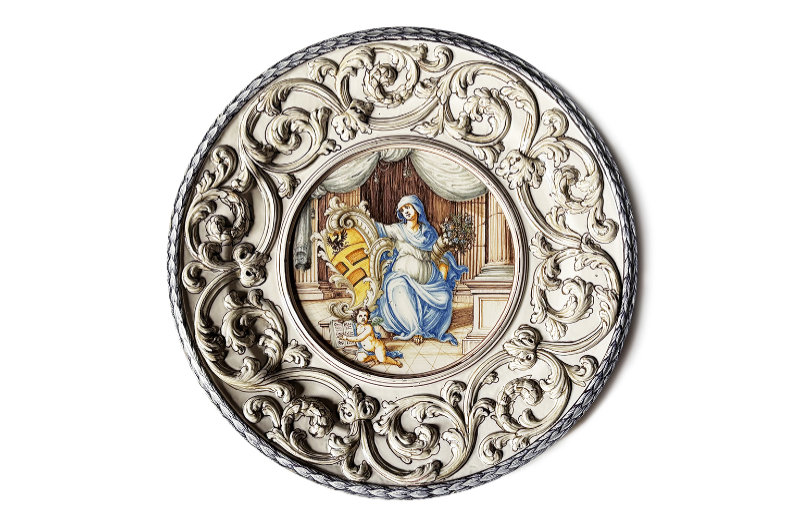
Polychrome Maiolica Dish with the Coat of Arms of the Pietra Family
Pavia Manufactory,probably under the management of Giovan Battista Africa for Rampini, 1693–1704
Painted by Siro Antonio Africa or Siro Domenico Africa
Dimensions: height (inches) 1,57 x diameter 18,89 (cm 4 x 48)
Weight: lb 3,70 (g 1,681)
Condition:
intact
This dish belongs to an important category of maiolica works representing some of the finest ceramic production of the late 17th and early 18th centuries. For a long time, this kind of ceramics was attributed to the Venetian village of Angarano (near Bassano del Grappa), but by the late 1990s it had definitively been reassigned to the principal manufactories of Pavia. See the study by E. Pelizzoni, M. Forni, and S. Nepoti, La maiolica di Pavia tra Seicento e Settecento, Milan, 1997.
The large circular dish, made in a mold, features a central well framed by a slender molded border. The broad, slightly sloping rim is decorated with relief motifs. These are highlighted in manganese purple and extend to the rounded cavetto molding.
The edge is rounded and decorated with a dense crown-like motif composed of small lanceolate leaves outlined in manganese and shaded in blue.
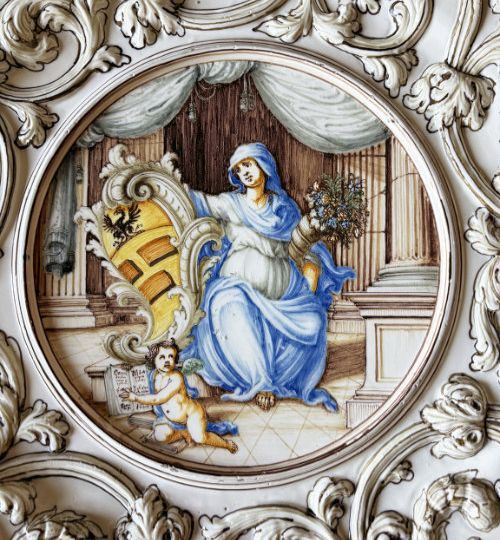
At the center of the well appears a seated female figure placed upon a plinth. She is dressed in a long grey-blue tunic and a pale blue mantle. She holds, with her right hand, the heraldic coat of arms of the Pietra family enclosed within a cartouche. Under her left arm she carries a cornucopia overflowing with flowers. At her feet a winged putto holds a book open.
The scene unfolds within an architectural setting of columns and pillars with a draped curtain.
The female figure should be interpreted as an allegory of Abundance or, according to the iconographic conventions of the period, Liberality. It has not yet been possible to identify with certainty the precise visual source that inspired the painter; however, the style recalls figures frequently employed by the Africa workshop, and derived from engravings by Giovanni Battista Dal Sole (after Cristoforo Storer), Giovanni Paolo Bianchi, or Giacomo Cotta.
The coat of arms – golden, with three recumbent red plinths beneath the chief of the empire – can be associated with the Pietra family from at least the time of Prior Clemente Pietra of the Order of Saint Stephen in the sixteenth century.
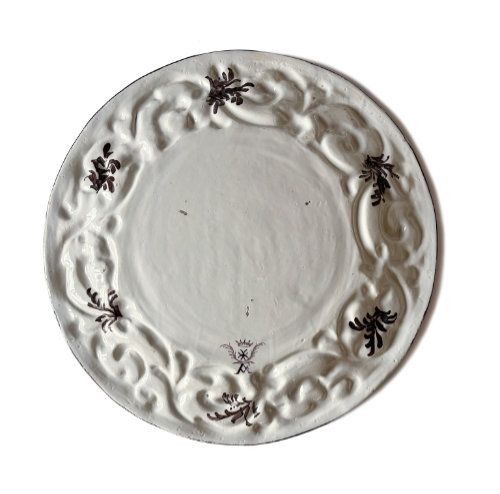
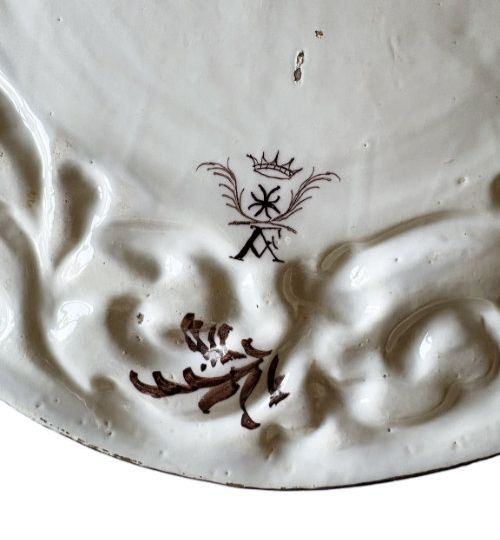
On the plate’s reverse are the typical sprigs with elongated leaves outlined in manganese frequently found on Pavia ceramics of this period. These appear along with the mark “AF” enclosed between two crossed palm fronds and surmounted by a small cross and pointed crown. Some scholars have associated this mark with the production of the Africa family painters active in Pavia (P. Ferrari, La famiglia Africa sposta dal Brenta al Ticino l’interpretazione della marca A.F., in “FIMAntiquari”, IV, 9, 1996). A compelling interpretation has also been proposed. This reads the initials as Africa fecit, possibly connected with the management of Giovan Battista Africa at the Rampini manufactory, where both Siro Antonio Africa and Siro Domenico Africa are documented as painters.
It nevertheless remains difficult to establish precisely in which manufactory the two Africa artists were working between the end of the seventeenth century and the beginning of the eighteenth. This is due to their frequent movement between the various Pavia workshops, including, from 1704 onward, that of the entrepreneur Agostino Ferri (E. Pelizzoni, op. cit., pp. 29–32).
On technical and stylistic grounds, the work appears, in our opinion, attributable to Siro Antonio Africa and therefore datable before 1704. Particularly noteworthy are the rounded face and features accented in manganese. Raised pigments have been used in the foot of the figure and details of the cornucopia, thus contrasting with the body which was rendered only in shades of bistre and blue.
The architectural elements are crisply outlined, as are refined details such as the tassels of the cords supporting the theatrical drapery. Especially accomplished is the figure of the putto, outlined in manganese, intent on holding a large open book while seated upon a pile of volumes, perhaps a symbolic tribute to the learned patron who commissioned the work.
The patron, identifiable through the heraldic device, belonged to the Pietra counts of Silvano Pietra, a small village in the Oltrepò Pavese over which the family held feudal rights from 1528 until the end of the eighteenth century. Of Pavia origin, the dynasty included distinguished figures particularly during the Renaissance, beginning with Brunoro I, senator of Milan and secretary to Dukes Massimiliano Sforza and Francesco II Sforza, who helped bring the village of the Oltrepò into the major political events of the time.
The wealth of the Counts Pietra also derived from the cultivation of woad, the precious blue dye used in the textile industry. Throughout the political events of the Sforza dynasty, the family distinguished itself through loyalty to the ducal house and received significant honors in return. At the same time, the Pietra family established strong ties with Charles V and his son Philip II of Spain, later also enjoying favor at the Medici court in Florence.
Between the late seventeenth and early eighteenth centuries, the family – connected through marriage with the leading Milanese houses – clearly embraced the fashion for collecting that led Lombard nobility to appreciate the extraordinary production of the Pavia ceramic manufactories, of which the present dish is a significant example (E. Pelizzoni, op. cit., p. 20).
Very few examples bearing the same coat of arms are known. Elena Pelizzoni has published a similar example: a pedestal dish with closely related stylistic features. It is decorated with an Allegory of Literature holding the same emblem – though surmounted by a crest – within an architectural setting and a landscape (E. Pelizzoni, op. cit., p. 21). The author further notes how the presence of Lombard heraldic devices proved decisive in narrowing the field of inquiry, confirming the Pavia origin of these maiolica wares (E. Pelizzoni, op. cit., p. 20 and bibliography related to note 46).
The decorator Siro Antonio Africa had worked alternately in the two main Pavia factories (Carlo Giuseppe Rampini and Antonio Francesco Imbres as documented from the last decades of the seventeenth century) where he signs his works in a different way (E. Pelizzoni in, op. cit., pp. 29-32). In the 1735 inventories of the Rampini manufactory, the maiolica are defined with Africa’s architectural motifs. He is considered among the initiators of refined decoration with architecture, of which this work is one of the finest examples. Preserved in the major ceramics museums of the world, the dishes of Pavia are considered among the most elegant works in eighteenth-century maiolica: we recall, among others, the plates of the New York Met (inv. 2018. 460), and those of the Cambridge Fitzwilliam (inv. C.252-1991).
BIBLIOGRAPHY:
- E. Pelizzoni – M. Forni – S. Nepoti, La maiolica di Pavia tra Seicento e Settecento, Milano, 1997.
- P. Ferrari, La famiglia Africa sposta dal Brenta al Ticino l’interpretazione della marca A.F., in “FIMAntiquari”, IV, 9, 1996.