

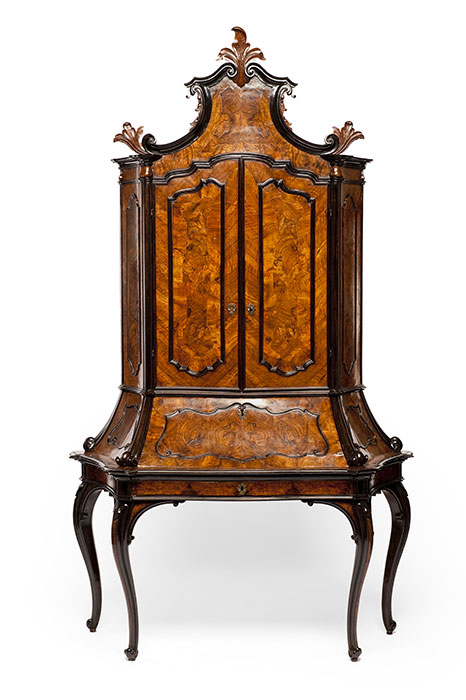
Bureau-cabinet with fold-down writing desk
(trumeau)
Milan, circa 1760
Walnut with carved decoration and walnut-burl veneer; applied ebonized wood trim and cornice
Measures:
Height: 104 in
Length: 60.6 in
Depth: 22.4 in
State of conservation:
very good.
The iron keys and locks are original.
The bureau-cabinet stands on four slender cabriole legs ending in scrolls. The lower part features a full width drawer with a writing surface above it that folds down to reveal a number of smaller drawers. The sides are strongly contoured, while the contours are less accentuated on the front. The lines of the lower part are continued in the sides of the upper section, which is a cabinet with two doors enclosing shelves. The vigorously mixtilinear crown features three applied rococo ornaments.
The desk is almost completely veneered in walnut burl with contrasting ebonized wood trim, edge molding, and cornices. The iron keys and locks are original.
This is a characteristic piece of Lombard furniture from the 1750s or ’60s. However, while this bureau-cabinet falls into the category known as trumò (trumeau) in 18th-century Milan, it does show a number of unusual traits for Lombardy. These may be seen in the choice by the designer, who was clearly receptive to Rococo tastes, to give his work high legs, softly contoured sides, and rococo decorations at the top.
The chromatic combination of walnut burl and ebonized wood, which was much in vogue in Lombardy for nearly the entire 18th century, identifies a late-Baroque style for the bureau-cabinet and helps dispel any doubts as to its provenance.
The excellent quality of the wood, the discerning arrangement of the veneer, and the elegance of the architectural design of the volumes and contours prompts us to attribute it to a workshop in the city of Milan, which is where the patrons who were most receptive to the spread of the Rococo style lived and where a good portion of high quality furnishings were commissioned and crafted.
Bibliography:
C. Alberici, Il mobile lombardo, Milano 1969
E. Colle, Il mobile Rococò in Italia, Milano 2003
Cover Photo: Fabrizio Stipari