

SOLD
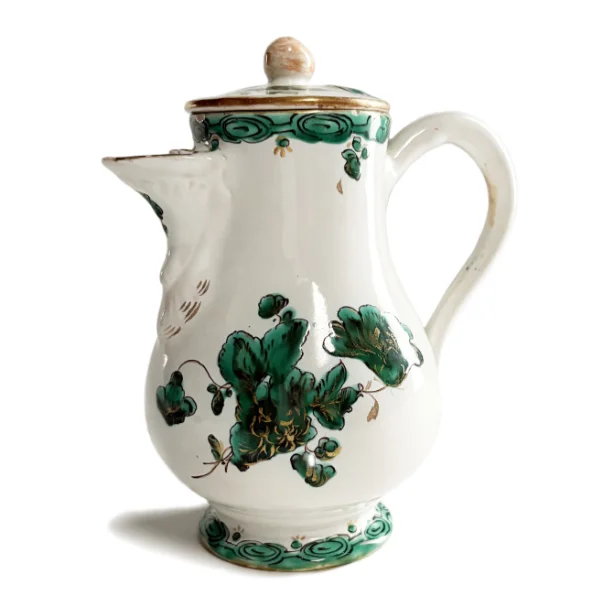
Small coffee pot
Pasquale Rubati Factory
Milan, 1780-1790
Third-fired green monochrome painted maiolica with gold highlights
It measures:
5.51 in in height x 5.31 x 3.15 (14 cm x 13.5 x 8.5)
It weighs:
0.53 lb (239 g)
State of conservation:
the body is in good condition with small signs of use on the rim. Lid has been restored from a clean break.
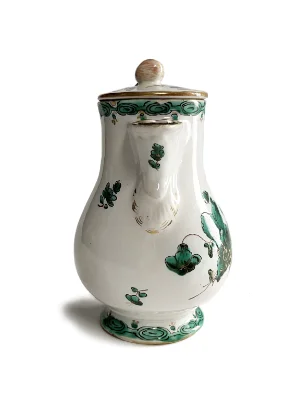

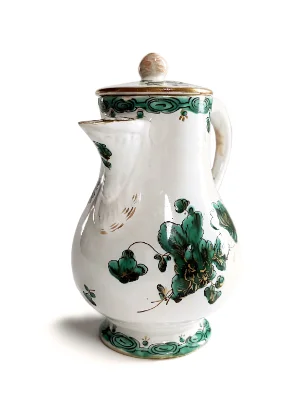
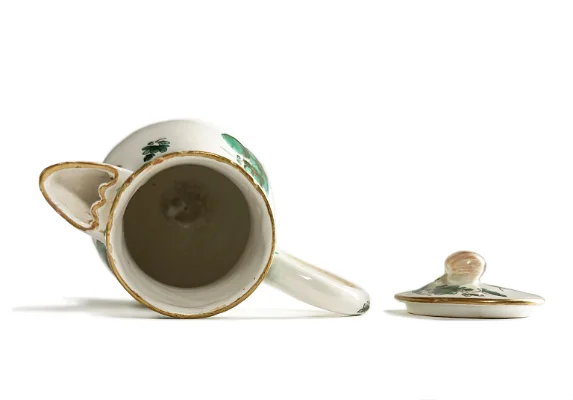
The small coffee pot is pear-shaped with a ribbed body and rests on a low flared foot. The spout is corbelled and decorated with reliefs. The handle, in the form of a simple partial ovular curve, descends in a wide arc to the body. The lid is flat and surmounted by a grip in the shape of a small fruit.
The decoration, in “Savy green”, is third-fired and covers the body with flowering bouquets of roses. Small secondary flowers are scattered along the surface. All is further embellished with abundant gold accents to emphasize the form and ornamentation while a continuous gold line adorns the edges.
The small shape is derived from more elegant Viennese models with a smooth handle and a flat lid contrasting with the movement of the spout. The morphological correspondence is in an elegant coffee pot without a lid. This bears refined decoration in the French style and lends itself well, along with the one under consideration, as an example of the fine pottery produced by Rubati for the Austrian aristocracy (R. Ausenda, a cura di, Musei e Gallerie di Milano. Museo d’Arti Applicate. Le ceramiche. II, Milano 2001, p. 415, n. 394).
For decoration, the closest comparison comes to us from some pieces held in the Museum of Applied Arts of the Sforzesco Castle in Milan (R. Ausenda, a cura di, Musei e Gallerie di Milano. Museo d’Arti Applicate. Le ceramiche. II, Milano 2001, pp. 396-399, n. 372).
The green monochrome draws inspiration from the French models produced in Marseille by the painter Honoré Savy, who, with his cut flower decorations in camaieu vert, is considered the initiator of a fashion which would mark the transition from Rococo polychromy to the new neoclassical rigour.
In Milan, Pasquale Rubati was the representative of this new decorative style, especially during the golden age of his production, that is, around 1780. Rubati, a refined painter, had opened his own factory in Milan in 1756, in competition with Felice Clerici, for whom he had been an employee.
For further information on Pasquale Rubati’s manufacturing, please refer to the recent text by R. Ausenda, La maiolica a Milano nel Settecento, Firenze 2025, especially for information regarding the green enamel flower decoration p. 278 e pp. 280-281.
Bibliography:
- R. Ausenda (a cura di), Musei e Gallerie di Milano. Museo d’Arti Applicate. Le ceramiche. II, Milano 2001, pp. 396-399, n. 372.
- G. Anversa in G. Beretti, M. Subert, a cura di, Con Molti e bellissimi fiori. Maioliche e tarsie a Milano tra Rococò e Neoclassicismo, catalogo della mostra, Milano 2023.
- R. Ausenda, La maiolica a Milano nel Settecento, Firenze 2025