

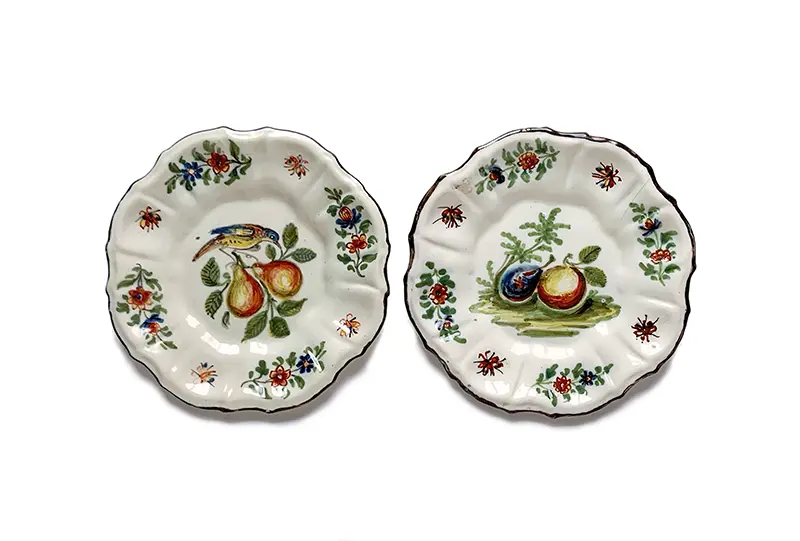
Two small dishes
Antonio Maria Coppellotti Manufacture
Lodi, Circa 1740
High fire polychrome maiolica
They measure:
Diameter 7.08 in (18 cm)
Weight: 0.37 lb (170 g)
State of conservation:
one is intact, with only minor chips along the edges and a thin fêlure; the second one is broken into three pieces with visible restoration on the back.
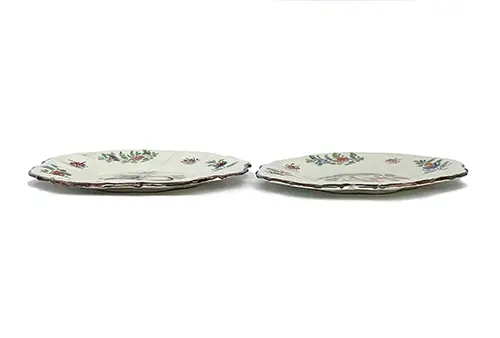
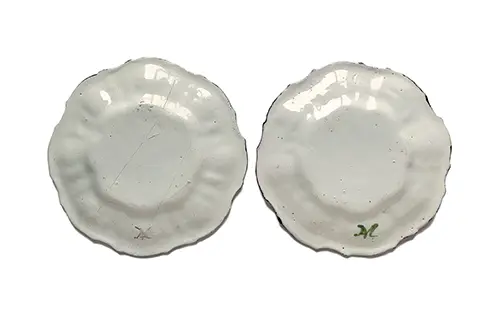
The pair of small plates features a traditional form without a support ring, with a short, slightly inclined, and mixed-line profile. The rim is undulating, scalloped, and bordered in brownish-brown.
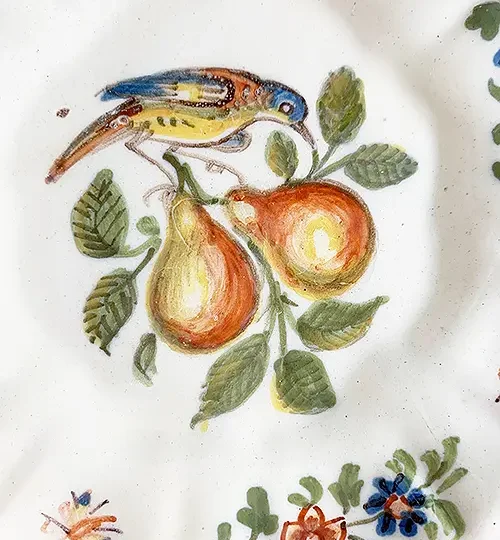
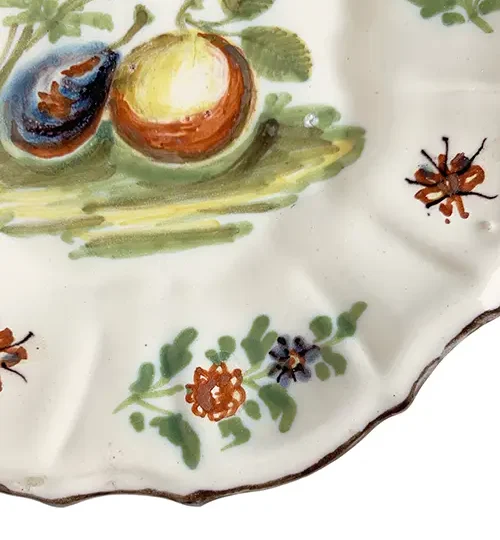
The high-fire polychromy decoration is executed over a thick, cream-white enamel in the first one and slightly darker in the other, with a few small air bubbles in both. In one specimen, positioned at the center of the composition, there is an “aerial” grassy mound upon which rests a small tree accompanied by two fruits: a plum and a peach. In the second dish, a leafy branch is painted with two small pears, and a polychromatic bird perches on it. In both dishes, the rim is decorated with the alternating pattern of flowering branches and polychromatic insects with long legs. Both of them bear the monogram “AMC” on the reverse, outlined in light green for one and brown for the other. The comparison of the “AMC” monogram confirms the attribution: reference can be made to some specimens exhibited in the Lodi exhibition of 1995. (M. L. Gelmini, Maioliche lodigiane del ‘700, Milano 1995, pp. 112-115; nn. 103-104).
Very close in terms of morphology and decoration, but slightly larger in size, is a dish (inventory number 325) with a similar ornamentation, now preserved in the Applied Arts collections of the Castello Sforzesco in Milan. (R. Ausenda, a cura di, Musei e Gallerie di Milano. Museo d’Arti Applicate. Le ceramiche. Tomo secondo, Milano 2000, p. 191, n. 231).
The two small dishes are indeed certain works of the Lodi manufacture by Antonio Maria Coppellotti, adhering to all of its compositional standards. These works can be placed within the peak period when, following Baroque canons, the “fruit” decoration became one of the most requested subjects. This style was then adopted not only by nearby Lombard factories but also by the Antibon manufacture in Bassano (G. Ericani, P. Marini, N. Stringa La Ceramica degli Antonibon, Milano 1990), and further in the Marche region (G. Biscontini Ugolini, Ceramiche pesaresi dal XVIII al XX secolo 1986 pp. 41-44).
The painting expertise of the decorators from Lodi, especially in color control, set a standard: the red, sourced from now-depleted Eastern quarries and known as “bolo armeno,” was carefully managed during firing. This was achieved by applying a thin brushstroke of enamel over the sections affected by the chromatic range. This technique helped contain the “boiling” of the color during firing, resulting in remarkable outcomes where the relief and red-orange color characterize the production.
The first mention of the Coppellotti family as potters comes from archival documents which record the official request of an unknown Giovanni Coppellotti to open a majolica factory in Lodi in 1674. The factory, located near the church of St. Philip seems to have been immediately quite successful. However, it was only in 1679, when the management of the factory passed to Antonio Giovanni Maria Coppellotti – the son or perhaps grandson of the original Giovanni – that the production reached the peak of success and became an example for the main Italian manufactures of the time, especially those in Veneto and Liguria. In 1728 the factory had to move outside the city walls at the behest of the authorities, who feared the possibility of fires.
The activity continued until about 1750, the year of Anton Maria’s death and resumed later with his son, Bassano Coppellotti, under the guide of some other directors, among whom we note: first, G. Moroni, followed by Giulio Berinzaghi and in 1771 Pedrinazzi. Finally, in 1787 a new municipal ordinance ordered the definitive closure of the manufactory.
The maiolica produced during the initial period are characterized by the use of a thick, velvety enamel and have ornaments ranging from monochrome turquoise with Italian (ruins, castles, flowers) and French motifs (“rabeschi”, ramage), to decorations in the manner of Chinese porcelain and oriental inspiration.
Of particular importance are ornaments of Baroque fruit which show the amazing relief effects produced by using the red tone called “Armenian bolus”. This great variety of decorations appeared between 1735 and 1740 by which time, alongside the production of turquoise monochrome, polychromy with high fire technique was firmly established. The brand precisely identifying the maiolica of this factory is rare and uses a woven “AMC” monogram. It was sometimes done in different colors and was sometimes accompanied by the names of the painters and modelers of the manufacture.
Bibliography:
C. Baroni, La maiolica antica di Lodi, in “Archivio storico lombardo” LVIII, 1930, pp. 448 s., 455-457;
A. Minghetti, I ceramisti italiani, Roma 1946, p. 129;
S. Levy, Maioliche settecentesche lombarde e venete, Milano 1962, pp. 15-17, tavv. 121-150;
G. Gregorietti Museo Poldi Pezzoli, Maioliche di Lodi, Milano e Pavia (catal.), Milano 1964, pp. 15 s., con ill.;
A. Novasconi – S. Ferrari – S. Corvi, La ceramica lodigiana, Milano 1964, pp. 23, 27, 34-36, 47, ill. pp. 53-121;
O. G. C. Sciolla, Museo civico di Lodi, Bologna 1977, pp. VIII s.; tavv. pp. 72-76, 78;
M. L. Gelmini, Maioliche lodigiane del ‘700, Milano 1995, pp. 112-115; nn. 103 – 104;
R. Ausenda, a cura di, Musei e Gallerie di Milano. Museo d’Arti Applicate. Le ceramiche. Tomo secondo, Milano 2000, p. 191, n. 231;
Felice Ferrari, La ceramica di Lodi, Lodi 2003.