

Skip to main content Scroll Top

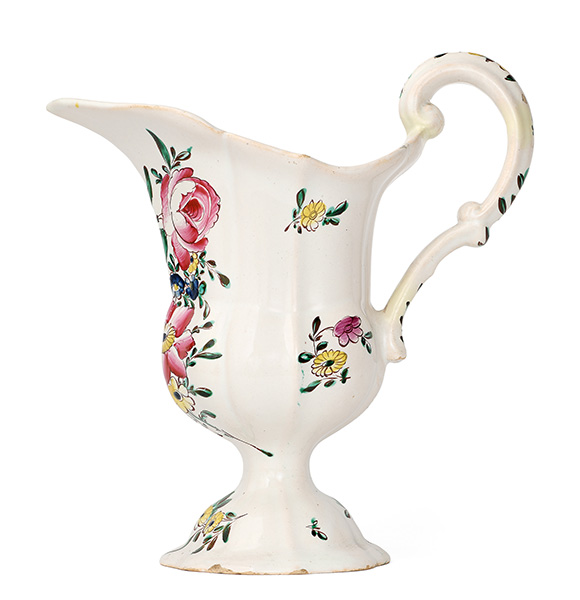
MAJOLICA PITCHER. ANTONIO FERRETTI, LODI 1770-1780

Versatoio di maiolica
Manifattura di Antonio Ferretti

Maiolica Pitcher
Antonio Ferretti Manufacture
Lodi, 1770 – 1780 circa

It measures:

Width: 22 cm
Depth: cm
Weight: 517

State of conservation:

slight wear and tear on the edge of the foot, camouflage gluing on the upper part of the handle.

The majolica pourer has a mouth with a long triangular spout and a shaped rim, slightly everted which rises at the back where the handle is inserted. This is carried high and is made up of two opposing “Cs”, one of which is curved. The ribbed body widens at the base to form a rounded calyx, which in turn narrows into a tall stem and widens again into a wide foot, pure ribbed, slightly everted and with a concave base.
The surface is covered with a thick white enamel and the painting is full-bodied, rich in material. The decoration, concentrated on the front, is composed of a bouquet of flowers and roses accompanied by flowers and leaves; flower seeds and leaves fill the remaining surface.
The pourer accompanied the complex eighteenth-century table setting with the hypothetical function of a vessel for pouring liquids: both, coupled with a tub, for washing hands, and for pouring the wine – not present on the table – offered by dedicated waiters into glasses to each diner.


The decoration used here with an outlined flower, painted in one go, with a lot of material added, is among the most successful in Antonio Ferretti’s Lodi manufacturing after 1760.
There are few similar works known in public or private collections in which the container has a stylistic, but not morphological, counterpart: it stands out for the complexity of the shape which has comparisons in the foot, but not in the handle with a similar work in a private collection of Lodi confirming the use of multiple molds in manufacturing (F. Ferrari, La ceramic di Lodi, Lodi 2003, p. 276, n. 230). More similar in terms of the morphology of the body and foot is a pouring vessel – also in a private collection – which shares with ours the stylistic choice of the outlined flower made with a large quantity of pigments, but with the bouquet of flowers distributed on the sides of the body (S. Levy , Eighteenth-century Lombard and Venetian majolica, Milan 1962, pl. 183).
This decorative choice represented a strong point of the Lodi factory which established itself thanks to the liveliness of the colors made possible by the introduction of the new technique perfected by Paul Hannong in Strasbourg and which Antonio Ferretti had introduced in Italy. This production process, called “small fire” cooking, allows the use of a greater number of colors than in the past; in particular, Cassian purple was introduced, a red color based on gold chloride, which allowed many more shades and shades to be obtained, from pink to purple.
The Ferretti family had started their majolica manufacturing business in Lodi in 1725.


The founder Simpliciano had started the business by purchasing an ancient furnace in 1725 and, in April of the same year, we have evidence of the full activity of the furnaces (Novasconi-Ferrari-Corvi, 1964, p. 26 n. 4). Simpliciano had started an excellent production also thanks to the ownership of clay quarries in the Stradella area, not far from Pavia. The production was so successful that in 1726 a decree of the Chamber of Turin prohibited the importation of foreign ceramics, especially from Lodi, to protect internal production (G. Lise, La ceramica a Lodi, Lodi 1981, p. 59 ).
In the initial phases the factory produced majolica painted with the “high fire” technique, often in blue monochrome, with decorations derived from compositional modules in vogue in France in Rouen, also thanks to the collaboration of painters such as Giorgio Giacinto Rossetti, who placed best examples have their name next to the factory logo.
In 1748 Simpliciano made his will (Gelmini, 1995, p. 30) naming his son Giuseppe Antonio (known as Antonio) as universal heir. After 1750, once Simpliciano had passed away, Antonio took charge of the majolica factory directly, raising its fortunes to reach a reputation at European level.
Particularly important was the aforementioned introduction in 1760 of the innovative “small fire” processing, which, by expanding the ornamental repertoire with floral themes of Saxon inspiration, was able to compete commercially with German porcelain which had one of its proposals in the naturalistic Deutsche Blumen most renowned.
Antonio Ferretti understood and promoted this technique and this decoration, re-proposing it in a fresher and more refined version, less linked to the botanical tables, in a contoured or cut-out version and also in purple or green monochrome.
After these happy experiences with the introduction of more industrial production techniques, even the Ferretti manufacture, in the last decade of the eighteenth century, headed towards decline, despite attempts to adapt production to neoclassical taste.
In 1796 the Napoleonic battle for the conquest of the Lodi bridge over the Adda definitively compromised the furnaces. Production resumed, albeit in a rather halting manner, until Antonio’s death on 29 December 1810. (M. L. Gelmini, pp. 28-30, 38, 43 ff., 130-136 (for Simpliciano); pp. 31 ff. , 45-47, 142-192 (for Anthony).

Bibliography:

C. Baroni, Storia delle ceramiche nel Lodigiano, in Archivio storico per la città e i comuni del circondario e della diocesi di Lodi, XXXIV (1915), pp. 118, 124, 142; XXXV (1916), pp. 5-8;
C. Baroni, La maiolica antica di Lodi, in Archivio storico lombardo, LVIII (1931), pp. 453-455;
L. Ciboldi, La maiolica lodigiana, in Archivio storico lodigiano, LXXX (1953), pp. 25 sgg.;
S. Levy, Maioliche settecentesche lombarde e venete, Milano 1962, pp. 17 sgg., tav. 183;
A. Novasconi – S. Ferrari – S. Corvi, La ceramica lodigiana, Lodi 1964, ad Indicem; Maioliche di Lodi, Milano e Pavia (catal.), Milano 1964, p. 17;
O. Ferrari – G. Scavizzi, Maioliche italiane del Seicento e del Settecento, Milano 1965, pp. 26 sgg.;
G. C. Sciolla, Lodi. Museo civico, Bologna 1977, pp. 69-85 passim; G. Lise, La ceramica a Lodi, Lodi 1981;
M. Vitali, in Storia dell’arte ceramica, Bologna 1986, p. 251;
M. A. Zilocchi, in Settecento lombardo, Milano 1991, pp. 492-496;
M. L. Gelmini, in Maioliche lodigiane del ‘700 (cat. mostra Lodi), Milano 1995,
R. Ausenda,a cura di, Musei e Gallerie di Milano. Museo d’Arti Applicate. Le ceramiche. Tomo secondo, Milano 2000, pp. 213-220;
Felice Ferrari, La ceramica di Lodi, Lodi 2003, p. 276, n. 230.

Cover Photo: Fabrizio Stipari