

Charles-François Delamarche
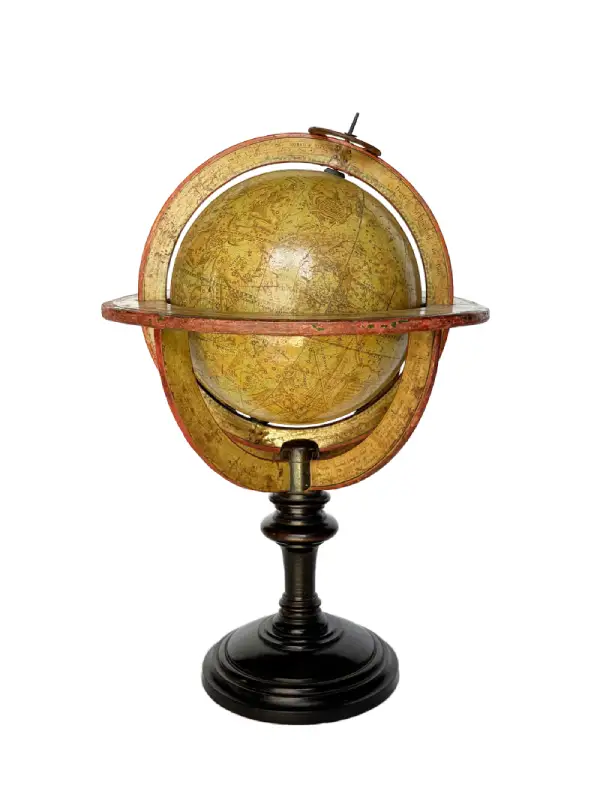
Celestial table globe
Charles-François Delamarche
Paris, 1791
It measures:
7.13 in in height, Ø max 27.7 in; the sphere Ø 7.09 in
(h 43.5 cm x Ø max 27.7 cm; the sphere Ø 18 cm).
Weight: 2.96 lb (1,344 g)
Wood, paper, papier-mâché and metal It rests on its original turned wooden column baseì.
State of conservation:
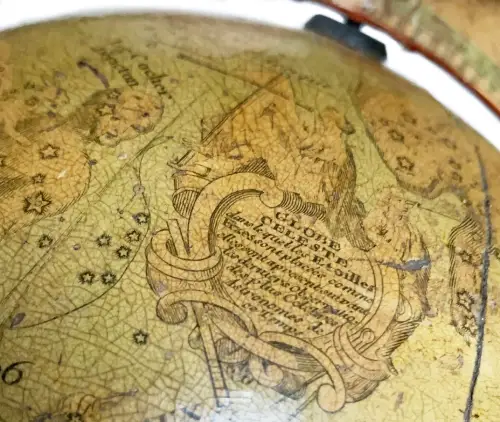
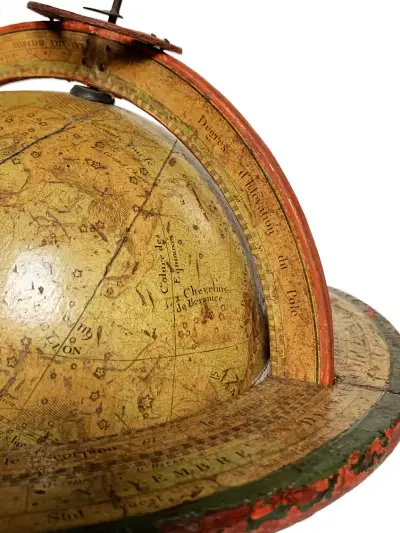
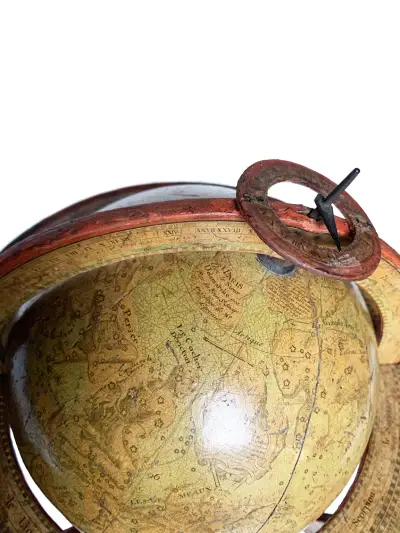
there are small, slight gaps, abrasions, stains and cracks due to use and aging.
- Van der Krogt, P., Old Globes in the Netherlands, p. 101
- Van der Krogt, P. – Dekker, E., Globes from the Western World, London 1993, p. 84.
- Dekker E., et al., Globes at Greenwich: A Catalogue of the Globes and Armillary Spheres in the National Maritime Museum, Greenwich, London, 1999, pp. 321 per la storia dell’impresa dei Delamarche.
Charles-François Delamarche (1740-1817)
Founded his laboratory around 1770 and, in a few years, he became the most famous French cartographer and globe maker spanning the 18th and 19th centuries. After having acquired the laboratory of the late Didier Robert de Vaugondy (1723-1786; himself a renowned cartographer who continued the family business founded by his grandfather Nicolas Sanson in the seventeenth century) and after having purchased, between 1788 and around 1800, the businesses of Jean-Baptiste Fortin (1750-1831) and Jean Lattré (around 1750-1800), Delamarche began to call himself “Successeur de MM. Sanson and Robert de Vaugondi, Géographes du Roi and de M. Fortin, Ingénieur-mécanicien du Roi pour les globes et les sphères”. Thus, at the end of the eighteenth century, Delamarche possessed the warehouse stocks, as well as the manufacturing skills of the globes of his main rivals in Paris. In addition to this aggressive acquisition policy, the key to his success also lay in the combination of high-quality cartography with extremely attractive globes and armillary spheres; and, of course, its famous red paint finishing touch. His laboratory was located in Rue de Foin St Jacques “au Collège Me. (or “Mtre”) Gervais” in the Latin Quarter of Paris until around 1805, when he moved to rue du Jardinet n. 13. On the death of Charles-François in 1817, the reins of the company passed to his son Félix (1779-1835), who continued to publish, often in collaboration with the engraver Charles Dien, Senior. In 1835 the company first moved to rue du Jardinet n. 12 and a little later to rue du Battoir n. 7.